
AI Health Assistant Development: 6 Smarter Ways to Monitor Glucose Data and Personalize Health Insights
Project Type: Custom AI Health Platform
Industry: Healthcare Technology
Core Capabilities: Health Data Integration, AI Analysis, Glucose Trend Prediction, Personalized Insights, Automated Notifications, Analytics Dashboard
Technology: Python, FastAPI, Django, React, Next.js, Llama 3, TensorFlow/PyTorch, PostgreSQL, Docker, Kubernetes
Building a Personalized AI Health Assistant Around Real-Time Health Data
Healthcare applications increasingly need to do more than collect information.
When glucose readings and other health signals are captured continuously, the real challenge is turning that information into something organized, understandable, and actionable for the intended user experience.
NeuralSol developed a custom AI health assistant designed around this challenge.
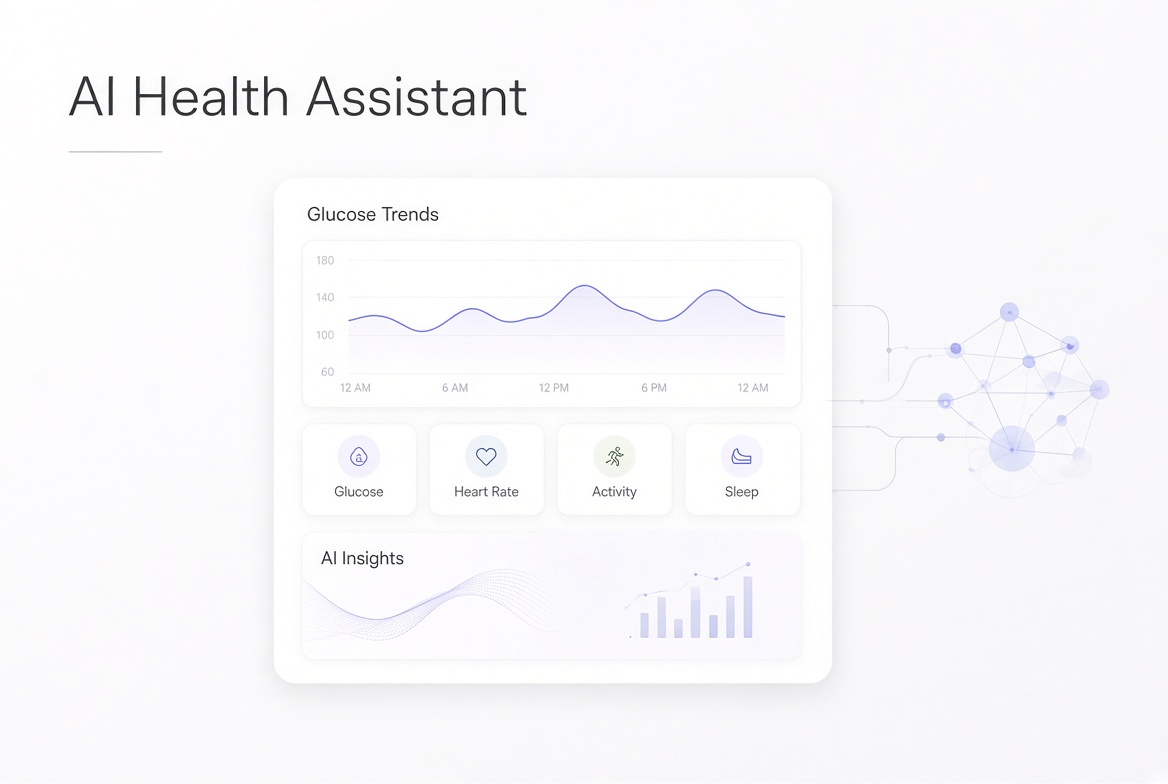
The platform brings together real-time glucose data ingestion, machine learning-based trend analysis, natural-language AI, automated notifications, and an interactive dashboard within a single software ecosystem.
Rather than treating AI as a standalone chatbot, the solution uses AI as one layer inside a broader application architecture.
The result is a foundation for a personalized health-monitoring experience where incoming data can move through a structured workflow:
Health Data → Analysis → AI Insights → Notifications → Dashboard
Important: This case study describes the software engineering and AI architecture of the platform. It does not represent the system as a medical diagnosis tool or a substitute for qualified healthcare professionals. Actual clinical, regulatory, privacy, and compliance requirements depend on the final product, intended use, deployment environment, jurisdiction, and applicable regulations.
The Challenge
A health-monitoring application can collect a large amount of information without necessarily making that information easier to understand.
Glucose readings may arrive from different sources, while optional signals such as heart rate, activity, or sleep can add further context.
The project therefore required more than a database and a dashboard.
The platform needed to connect several different capabilities:
- Real-time health-data collection
- Data validation and normalization
- Historical health-data storage
- Short-term glucose trend analysis
- AI-generated natural-language insights
- Configurable notifications
- Interactive analytics
- Mobile-friendly access
- Secure authentication and data handling
The challenge was to create one experience where these components could work together without making the product feel like a collection of disconnected tools.
The Solution
NeuralSol designed and developed a fully custom AI health assistant platform around a modular architecture.
The solution combines six major capabilities:
1. Real-Time Health Data Collection
The platform can receive glucose readings and optional health information from connected APIs or supported data sources.
2. Intelligent Data Processing
Incoming information is validated, normalized, associated with the appropriate user, and stored for future analysis.
3. Machine Learning Analysis
Recent glucose history can be processed by a custom machine learning model to estimate short-term trends.
4. Natural-Language AI
Llama 3 is used to transform structured analytical information into understandable, user-facing insights.
5. Automated Notifications
The platform can deliver configurable notifications through email, SMS, or push notifications.
6. Personalized Dashboard
Users can review current information, historical trends, AI-generated insights, and notification activity through a responsive web experience.
Together, these capabilities turn the application into a connected health-data platform rather than a simple AI chatbot.
How the AI Health Assistant Works
The experience begins when health information enters the platform.
A connected device or API sends a reading to the backend. The ingestion layer validates the incoming data and prepares it for storage.
The processed information is then available to the analytical layer.
Recent readings can be evaluated by the machine learning component to identify short-term patterns. The resulting structured information can then be passed to the language-model layer.
Llama 3 converts approved analytical information into natural-language insights that are easier for users to understand.
If configured conditions require an alert, the notification engine creates a notification record and sends it through the selected channel.
The resulting information is then available through the dashboard.
This creates a continuous application workflow:
Collect → Process → Analyze → Explain → Notify → Review
6 Key Capabilities Built Into the Platform
1. Real-Time Glucose Data Integration
The first requirement was creating a reliable path for health information to enter the application.
The Python-based ingestion layer receives data from APIs or supported health-data sources and prepares it before it reaches the analytical system.
The platform can work with information such as:
- Glucose readings
- Heart rate
- Activity information
- Sleep information
- User-entered health information
- Measurement timestamps
Data validation and normalization are important because different sources may return information in different formats.
The result is a more consistent dataset that can be used by the rest of the platform.
For future interoperability requirements, healthcare systems can also consider established standards such as HL7 FHIR, which defines a framework for exchanging healthcare information electronically.
2. AI-Powered Glucose Trend Analysis
The platform uses a custom machine learning component to analyze recent glucose information.
The initial workflow considers a recent historical window, such as 24 to 48 hours of available readings, and uses a TensorFlow or PyTorch model to analyze short-term patterns.
The purpose of this layer is to generate structured analytical information that the rest of the application can use.
The architecture intentionally keeps the predictive model separate from the language model.
This distinction matters.
The predictive layer handles numerical and time-series analysis.
The language model handles natural-language generation.
Separating the two makes it easier to evaluate, replace, improve, and monitor each component independently.
No unsupported accuracy percentage or clinical performance claim is made here because model performance depends on the training dataset, validation methodology, target population, input quality, and intended use.
3. Personalized AI Insights
Raw predictions are not always easy for a user to interpret.
The platform therefore introduces a natural-language AI layer using Llama 3.
Instead of exposing users directly to model output, the application can provide structured information to the language model and generate a more understandable explanation.
The AI layer can use relevant context such as:
- Recent health readings
- Historical trends
- User information
- Activity information
- Analytical results
- Application-defined rules
The generated insight is then stored as an AI analysis record.
This creates a history of generated insights rather than treating every AI response as a temporary conversation.
NeuralSol’s broader experience with custom LLM applications is also reflected in its NLP and LLM AI application development work.
4. Intelligent Notifications
A health-monitoring experience becomes significantly more useful when important events can reach the user without requiring them to constantly open the application.
The platform therefore includes a dedicated notification layer.
Depending on the configured workflow, the system can send:
- Email notifications
- SMS notifications
- Push notifications
- Daily summaries
- Weekly summaries
- Alerts associated with configured conditions
The system also records notification status.
For example:
Pending → Sent
or
Pending → Failed
This gives the application a record of notification activity and makes failed deliveries easier to identify.
The notification architecture uses technologies such as SMTP/SendGrid for email, Twilio for SMS, and Firebase Cloud Messaging for push notifications.
5. Personalized Health Dashboard
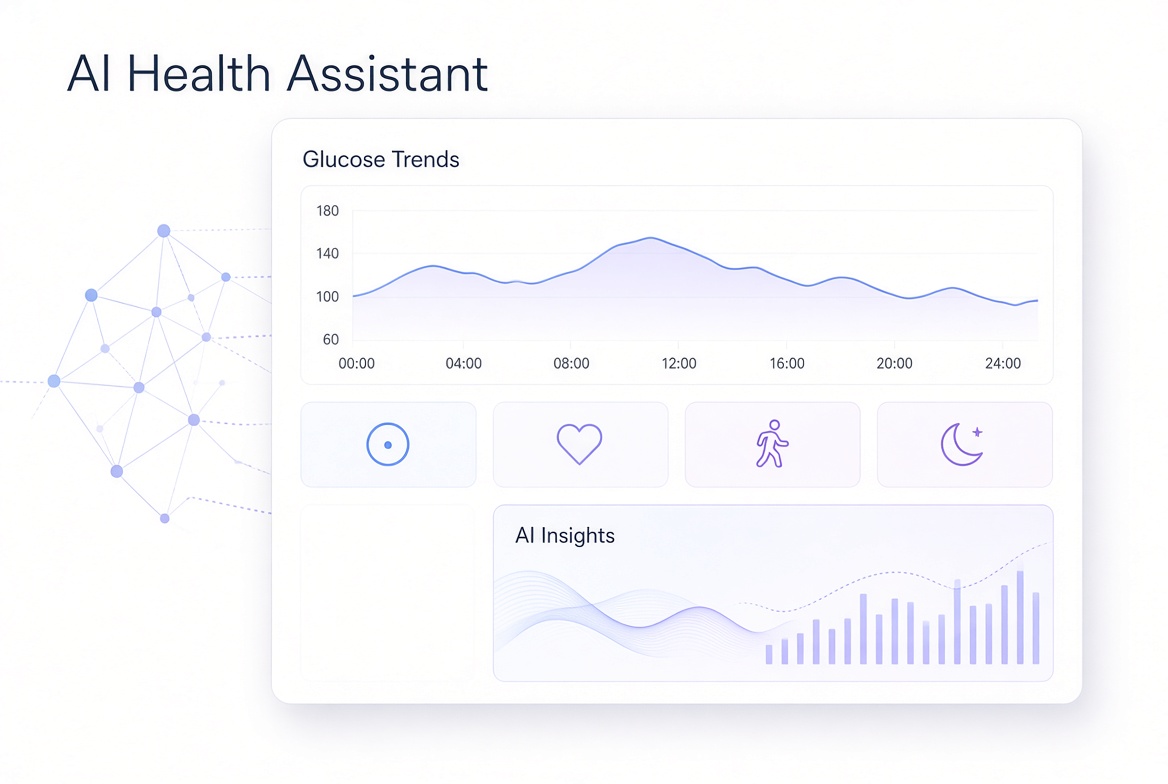
The dashboard provides one place to review information generated by the platform.
The interface can display:
- Current glucose information
- Historical glucose trends
- Daily trends
- Weekly trends
- Monthly trends
- AI-generated insights
- Notification history
- Optional heart-rate information
- Optional activity information
- Manually entered health information
Interactive visualizations can be implemented using charting libraries such as Chart.js or Recharts.
The frontend was built with React.js and Next.js, with Tailwind CSS used for the interface.
The platform can also be delivered as a Progressive Web App, giving users a mobile-friendly experience without requiring the entire product to depend on a native mobile application.
For products that require dedicated mobile applications, NeuralSol also provides custom mobile app development.
6. Secure, Modular Application Architecture
Health-related information requires careful handling.
The platform therefore incorporates security controls throughout the application rather than treating security as a final-stage feature.
The architecture includes:
- HTTPS for API communication
- Secure password storage
- JWT-based authentication
- Token expiration
- Access-controlled APIs
- Encryption of sensitive data at rest
- Audit logging
- Controlled access to stored information
- Secure handling of application credentials
The architecture can use encrypted local storage or AWS S3 for attachments depending on deployment requirements.
For security planning, healthcare software teams can also reference established cybersecurity guidance such as the NIST Cybersecurity Framework, rather than relying solely on application-level controls.
A Connected Architecture for Health Data and AI
The AI Health Assistant application was designed around a clear separation of responsibilities.
Health Devices / External APIs
            │
            ▼
     Data Ingestion Layer
            │
            ▼
   Validation & Normalization
            │
            ▼
       PostgreSQL
         /      \
        /        \
       ▼          ▼
ML Prediction   AI Analysis
    Model        Llama 3
       \          /
        \        /
         ▼      ▼
      Notification
         Engine
            │
            ▼
   React / Next.js Dashboard
This structure allows individual components to evolve without requiring the entire platform to be rebuilt.
For example, a future version could introduce a different prediction model while keeping the API, database, dashboard, and notification layers largely independent of that change.
From Data Collection to User Insight
The complete AI Health Assistant experience can be summarized in five stages.
Stage 1: Collect
The system receives glucose and optional health data.
Stage 2: Understand
The backend validates and normalizes the information before storing it.
Stage 3: Analyze
Machine learning models evaluate recent historical information and generate structured analytical output.
Stage 4: Explain
The Llama 3 layer turns approved analytical information into natural-language insights.
Stage 5: Engage
The notification engine and dashboard deliver the resulting information through the user’s preferred experience.
This workflow allows AI to become part of the product’s core experience without making the entire application dependent on a single AI model.
Technology Behind the Solution
The platform uses a modern full-stack architecture selected around the project’s requirements.
| Area | Technology |
|---|---|
| Backend | Python, Django, FastAPI |
| Frontend | React.js, Next.js, Tailwind CSS |
| AI / NLP | Llama 3 |
| Machine Learning | TensorFlow / PyTorch |
| Database | PostgreSQL |
| SMTP / SendGrid | |
| SMS | Twilio |
| Push Notifications | Firebase Cloud Messaging |
| Storage | Encrypted storage / AWS S3 |
| Containerization | Docker |
| Infrastructure | Kubernetes |
The technology choices were not made simply to add more tools to the stack.
Each component has a specific role within the overall product.
Why a Custom AI Architecture Was the Right Approach
A general-purpose chatbot could answer health-related questions, but it would not solve the underlying product requirements.
This project required a system that could:
- Receive structured data
- Maintain historical records
- Analyze time-series information
- Generate user-specific insights
- Trigger automated workflows
- Track notification activity
- Present historical analytics
- Support authenticated users
- Provide a foundation for future integrations
That required AI to work together with backend services, databases, APIs, analytics, and the user interface.
This is the difference between adding an AI chatbot to an application and building an application around an AI-enabled workflow.
NeuralSol’s AI Agent Development services follow the same broader principle: AI is integrated into a complete software workflow rather than treated as an isolated feature.
Security, Privacy and Healthcare Considerations
Because this type of platform can process sensitive health information, privacy and security must be considered alongside functionality. For example, whether a specific healthcare software function is subject to medical-device regulation depends on its intended use and functionality. The U.S. FDA’s January 2026 Clinical Decision Support Software guidance explains that some software functions may fall outside the device definition while others can remain subject to FDA oversight.
The architecture includes controls such as encryption, authentication, access management, and audit logging.
However, technical security features should not automatically be described as legal or regulatory certification.
For example, whether a specific healthcare software function is subject to medical-device regulation depends on its intended use and functionality. The U.S. FDA’s January 2026 Clinical Decision Support Software guidance explains that some software functions may fall outside the device definition while others can remain subject to FDA oversight.
For that reason, the platform should undergo appropriate legal, regulatory, privacy, security, and clinical review before being deployed for a regulated medical use case.
This distinction is important when building responsible healthcare technology.
Designing for Future Healthcare Integrations
The architecture was designed so additional health-data sources can be introduced over time.
As healthcare ecosystems become more interconnected, standards such as HL7 FHIR can provide a structured approach to exchanging healthcare information between systems. FHIR includes resources and APIs designed to support interoperability across healthcare applications.
A future implementation could therefore extend the platform toward:
- Additional wearable integrations
- More health-data APIs
- Standardized healthcare-data exchange
- Expanded analytics
- Additional AI models
- Clinician-facing interfaces
- Advanced audit capabilities
- Native mobile applications
- Multi-tenant deployments
The exact implementation would depend on the product’s intended users, integrations, regulatory requirements, and deployment environment.
Project Outcome
The completed architecture provides a foundation for a personalized health-monitoring application that brings together data collection, AI analysis, notifications, and analytics.
The platform can:
- Ingest real-time glucose and optional health information
- Normalize and store historical measurements
- Analyze short-term trends with machine learning
- Generate natural-language AI insights
- Deliver configurable notifications
- Present interactive historical analytics
- Support mobile users through a PWA
- Maintain records of AI analysis and notification activity
- Scale application services through containerized infrastructure
Because the architecture is modular, individual capabilities can evolve without requiring a complete rewrite of the application.
The result is a flexible foundation for organizations exploring AI-enabled health-monitoring products while keeping data processing, AI analysis, communication, and user experience clearly separated.
The Engineering Value
The strongest part of this project was not simply the use of Llama 3 or machine learning.
It was the way the individual technologies were connected into a coherent product.
A glucose reading becomes useful when the system can receive it reliably, store it correctly, analyze it, put the result into context, communicate it clearly, and make it available through a usable interface.
That required software engineering across the full product lifecycle:
Data → Backend → AI → Automation → Interface → Infrastructure
This is where custom AI development can create value beyond a standard chatbot integration.
Why NeuralSol
NeuralSol develops custom AI-powered software for businesses that need systems built around their specific workflows, data, and product requirements.
The team works across:
- AI agents
- LLM applications
- AI-powered web applications
- API integrations
- Workflow automation
- Custom software
- Mobile applications
- WordPress and WooCommerce solutions
The NeuralSol portfolio provides additional examples of custom software and AI-related project work.
Looking to Build an AI Health Platform?
Building an AI health assistant application requires more than connecting an LLM to a frontend.
The product may need reliable data ingestion, machine learning, AI orchestration, secure APIs, historical analytics, notifications, cloud infrastructure, and a user experience designed around the people who will actually use it.
NeuralSol can help organizations design and develop custom AI software around those requirements.
Whether the product involves health-data monitoring, predictive analytics, AI-assisted workflows, or another specialized use case, the architecture should begin with the product problem rather than the AI model.
Interested in building a custom AI-powered platform? Explore NeuralSol’s AI Agent Development and NLP and LLM AI Application Development services.
Project Snapshot
Project: Personalized AI Health Assistant
Industry: Healthcare Technology
Primary Capability: Glucose Monitoring and AI-Assisted Health Insights
Architecture: Custom API-Driven Platform
Backend: Python, Django, FastAPI
Frontend: React.js, Next.js, Tailwind CSS
AI: Llama 3
Machine Learning: TensorFlow / PyTorch
Database: PostgreSQL
Notifications: Email, SMS, Push
Deployment: Docker / Kubernetes
Mobile Experience: Progressive Web App
About This Case Study
This case study is based on the system architecture and capabilities provided by the NeuralSol engineering team for the project. Technical implementation details are presented to explain the engineering approach and should not be interpreted as clinical performance claims, medical advice, or regulatory certification.
Case Study Author: NeuralSol Engineering Team
Focus: AI Software Development, Machine Learning, Health Data Systems
Company: NeuralSol